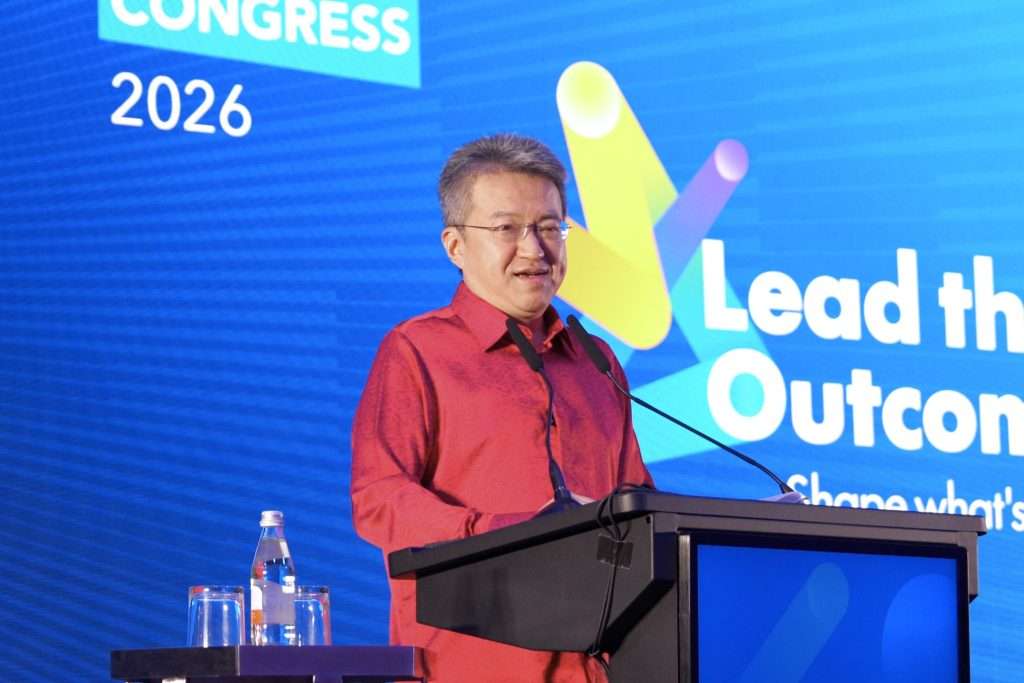
Accountant’s Mission in the New Era
It gives me great pleasure to welcome fellow Malaysians and international delegates to the CPA Congress 2026. I visited the Malaysian Institute of Accountants last week to discuss the long-awaited…


May I thank Datuk Prof Dr Mohd Faiz Abdullah, Chairman of ISIS Malaysia, for inviting me to this conference with the theme “Realising an AI nation”.
The recent global debates about artificial intelligence are couched in apocalyptic terms – such as 10%, 25%, or 50% of humanity would be obliterated, which in my opinion is hyperbolic. However, the advent of AI is still the most dramatic technological advancement since the invention of the internet.
Since the Industrial Revolution in the 18th century, the world has seen dramatic economic changes powered by new technologies, from steam engines, rail roads, telephone and telegram, electricity, automobiles, then to transistors in 1947, microprocessors in 1971, the world wide web in 1993, the smart phone in 2007, and here we are now, the AI era.

Technology and the market
Each major technology change in the past came with the massive euphoria and investments that at some point would end up as financial bubbles; there were also intense searches for new markets as well as extra production inputs which often coincided with one or the other form of colonialism.
The search for markets and sources of natural resources for European powers in Asia and Africa throughout the 19th century and early 20th century was essentially driven by technology changes which provided the technology-owning nations the military might via new weaponry and much bigger and faster ships to sail to faraway destinations, and gunboat their way to prosperity, at the expense of the less fortunate people of the colonised nations.
Liaquat Ahamed’s 2026 book with the title “1873: The Rothschilds, the First Great Depression, and the Making of the Modern World” is an interesting read about the panic of 1873 in Europe that caused the United States market to crash and the end of the post-Civil war railroad build out euphoria. It was followed by two decades of depression and slow growth across the globe.

The Imperial China experience
Euphoria and hype in investment into new technology played a role in the demise of the Qing Dynasty in 1911 in an interestingly roundabout way. Ford’s Model T – the first-ever mass-produced car in history – came about in 1908. Asia’s then largest stock market was in Shanghai while Malaya was the production site for natural rubber, which was seen as the best material for tyres. There was a frenzy of rubber stocks bearing names of Malayan towns, such as Senawang, and Kota Baru, listed on the Shanghai stock exchange in 1909 and especially 1910.
From the 1840s, China suffered multiple invasions by foreign powers since the Opium War. The Imperial Court suffered a deep legitimacy crisis especially after the 1900 Boxer Rebellion which saw the Emperor and Empress Dowager fleeing from Beijing to Xi’an. By about 1905, devolution of power to the provinces was used as a way for the government to renew legitimacy. Provincial assemblies were set up and many of those provincial autonomous governments went on to issue bonds to raise funds to build railroads.
By mid-1910, the United States imposed a trade barrier against the consumption of rubber from Malaya. Shortly after, the rubber stocks on the Shanghai Stock Exchange collapsed, resulting in the collapse of Chinese native banks (qianzhuang), something akin to the private lenders of today.
Corrupt provincial governments siphoned off railroad funds invested by ordinary folks into speculative rubber stocks, and when the market crashed, the railroad investors rose to protest, especially in Sichuan, and as the elite troops were diverted from Wuchang to quell the protest, the vacuum permitted the revolution to occur in Wuchang in October 1911 which spread like a wild fire, and finally bought down the dynastic government.

What do we learn from history?
That new technology brings progress, be it changes to the way we travel or the way information travels, the way we use energy sources, and ultimately the way we live.
At the same time, the technology owners – be it the nations or the capital owners, and often their interests align – would search for markets and sources of inputs and resources by any means, including colonialisation.
And, that the financial euphoria about new technologies don’t often end well though that has not affected the continued usage and spread of the technology itself. The many railroad bubbles did not stop the building of railways, just like the dot.com bubble did not stop the use of the internet.
Let us return to the case of Malaysia and think about what we should do. We don’t live in an ideal world and, as we can see, technology is not neutral to geopolitics and dominance, and not immune to crises when capitals or great powers overreach.
Like any of the previously new technologies, AI will certainly bring progress in terms of better quality of life and massive increase of productivity. But more than ever, we can see that very clearly in 2026, that it is also about a quest of technology ownership, dominance, and capital accumulation and concentration at the hands of a very select few.
The cliche that “if we are not at the table, we will be on the menu” probably encapsulates my core message.

Malaysia’s resilience
In the three decades or so since the end of the Cold War, the world was mostly influenced by neoliberal ideas of the pursuit of efficiency and unbridled trade. That neoliberal ideas are now seen as naive and bankrupt as it is now proven that the world is not flat, and wars, geopolitics, pandemics, climate change, the quest of economic dominance, are not going away and becoming more prominent.
Resilience is now the core concern of states, economies, and corporations. The war on Iran and the Straits of Hormuz crisis has shown that Malaysia is one of the most resilient economies in Asia. Malaysia grew by 6 percent in the second quarter and 5.7 percent in the first half. The Malaysian economy grew on at least six engines if not more, namely the two sides of the AI boom, i.e. the semiconductor industry and data centres, the two sides of the resource economy, i.e. palm oil and the oil & gas industry, and services sector, i.e. tourism and other services such as logistics and regional headquarters.
And it is in this context, I am of the view that Malaysia is in our best position since the Asia Financial Crisis in 1997. For three decades, Malaysia has not been the most relevant economy in the region or in the world, in part because after the 1997 Asian Financial Crisis, Malaysia lost its purpose to a certain extent, lost its ambition to a large extent, followed by the political crisis in 1998 which saw Dato’ Seri Anwar Ibrahim being imprisoned. And importantly, in 2001, China joined the WTO and China could do things cheaper at scale, with a lot more skill and technological sophistication, and Malaysia lost its relevance.
But the world has shifted from the pursuit of efficiency to now the pursuit of resilience, and we are a resilient nation. We should at least be ambitious enough to be a “mini Korea” in terms of technology and the way our economy is structured – a mini Korea in the AI age – so that when we look back in 30 years’ time, we will be a different economy. We must make the right choices now. We have the last 30 years behind us, and we have the next 30 years ahead of us.
Towards “Made by Malaysia”
Malaysia must aim to own more technologies and not just remain a user. Circling back to the question of being at the table or on the menu: the 13th Malaysia Plan and National Budget place significant emphasis on moving from “Made in Malaysia” to “Made by Malaysia.” We need to see Malaysian companies owning technology and not just continuing to be outsourced manufacturers. There’s a tendency among policymakers, among Malaysians, and even among foreign investors to see Malaysian companies as only capable of being part of the supply chain and not being able to own technology. That is something we have to correct in this generation.
We must demand technological transfer and a lot more local buy-in when there is foreign investment, so that Malaysian companies could eventually emerge as regional champions, if not globally relevant. This is where we need a different way of looking at Malaysia.

The Three Middles
Of course, we are not aiming to be the top tech nation tomorrow; it takes time. That’s where the idea of the “Three Middles”, which I’ve spoken about on other occasions, comes in. We should position Malaysia in the following middles:
The first middle is to see Malaysia as the indispensable middle in the global supply chain and in technological ownership. We are not going to chase for the top tech tomorrow; we accept that, especially in the context of US-China competition, we are in the middle in terms of technology. We are chasing to fortify our position as the indispensable middle.
For example, in 2023, I went to Detroit for a meeting and met the then-Commerce Secretary of the United States, Gina Raimondo, told a group of Asian ministers that when Covid-19 happened and Malaysia had a lockdown, Detroit had to shut down too because the automotive chips produced in Malaysia were not being produced. The indispensability is there, but we need to continue to fortify that position.
The second middle is about being geopolitically in the middle. We are friends to all and enemy to none. We work with the Americans, we work with the Chinese, but at the same time, we work with other middle powers to ensure that we are geographically centered and balanced. It is a tough call to balance, and it’s a tough call not to get stuck in geopolitical and technological bifurcation.
There will be a lot of pressure on us to take sides in technology, but under the leadership of Prime Minister Anwar, it is clear that we want to stay in the middle. Staying in the middle is a very difficult but important line to hold.
The third middle is to create a strong middle class. We must be very clear that the years to come are about creating a strong middle class in Malaysia. We must see more Malaysians becoming richer before we get older, and see Malaysia and the region as a consumer market, not just a production site. For the longest time, the world saw the United States as the sole destination for exports, and therefore countries in our region competed in a race to the bottom by pressing down prices, offering elaborate incentives to foreign investors, and even destroying our environment to suit their needs.
We have to do it differently. We have to protect ourselves, safeguard our society, and create a strong middle class here. In the years to come, we cannot see the United States as the only destination for exports; we must create domestic and regional markets.
The data centre predicament
In this context, I want to turn to the question of data centres. Data centres are now a hot political potato across the globe, especially in the United States. There are many data centres being built in Malaysia, and more have applied to build. We do not have to take a black-and-white, yes-or-no approach toward data centres. What we need to do as a nation is to ensure Malaysia extracts the most value from their presence, and ensure there is a whole-of-government approach toward handling them, thinking through the benefits and risks. The risks have to be fully understood across the board.
I hope Tenaga Nasional Berhad (TNB), the banks, the developers, and the landowners are not too overexcited by data centre investments. It’s important not to be overexcited. There are instances of phantom demand but the government has competently detected and managed this, and the Energy Commission played a very positive role in ensuring there is no phantom demand in data centres.
There will be more such situations which we need to be clear-eyed about. Two problems come to mind:
First, we must move away from thinking in silo, because the challenges we face are multifaceted. They may come all at once and in a systemic manner. The banks, institutional investors like GLCs and GLICs, energy companies, and investment agencies all have to come together to think this through, ensuring there is no systemic threat to our financial system and broader livelihoods.
As I mentioned earlier, when we see patterns of circularity in financing AI, we must remember that previous crises were caused by new technology euphoria coupled with impulsive financial architecture. We must ensure we do not face that. Removing silos in government and in the wider society when dealing with AI is crucial.
Second, a common problem in Malaysia is that we are still stuck in a land trap. There is a book by Mike Bird titled “The Land Trap” that discusses this. When it comes to data centres, we are still talking about landowners selling land to developers, and developers trying to build data centres for foreign investors. We are still talking about land and malls. It is time for us to move away from having land at the center of our economy.
If Malaysia is to become a “mini Korea,” we must move away from developers being the biggest counters on the stock exchange. We need to move away from land-based thinking and developers merely building housing and industrial estates, and shift into thinking about what we can do as a nation in terms of owning technology.

AI and democracy
On the question of democracy, AI is helpful in increasing productivity, but it could also be a threat to jobs and a danger to democracy. This is where we need to fortify our nation as a resilient nation. Ultimately, resilience depends on people coming together. We need to deal with defense, security, and every other aspect, but uniting the people is very crucial.
When we think about the AI era, we cannot run away from dealing with both sides of the challenge to democracy. On the one hand, democracy is threatened by foreign influence, scams, and fake news that endanger our democratic life and social fabric. We have to deal with that by bringing our people together and ensuring our citizens are well-educated democratically to withstand those challenges.
On the other hand, it is about jobs. A lack of jobs is a direct threat to democracy. Whatever the development of AI, we must ensure our population continues on the path of becoming middle class, with sufficient jobs to go around. If AI takes away labour jobs, we must ensure to replace them.
In Malaysia, many routine jobs are done by foreign workers, but we must ensure that displaced workers are transitioned into high-value, middle-class jobs, whether in services or in manufacturing. If we can deal with that, and if we can hold the line on the “Three Middles”, Malaysia has the opportunity to be a great nation.
Let us look at the Ekonomi MADANI framework. It is actually like a house: it has a floor which the Prime Minister intends to raise; it has a ceiling that represents our ambition to reach for the stars and become a stronger, more robust economy. Raising the floor and raising the ceiling, with good governance as the third component.
When we think about this house, this era also calls for us to be concerned about having a door. You have the floor, you have the ceiling; it is time to have a door to ensure that we welcome the best and filter out the not-so-good. Having that door means that in times of global chaos, in times when neoliberal assumptions have waned, and in this fast-moving AI era, we decide as a nation what to open to, who to open to, and how to ensure our people and our democracy are protected from external threats.
Ultimately, a house is just a house. Therefore, we need to turn the house into a home. A home must be a place where our people feel they belong. To have that feeling, we need to ensure our people feel proud of this nation, feel dignified that our democracy is robust, and feel happy that Malaysia continues to grow into a more developed and mature nation.
This is my keynote address delivered at the AI Conference: Realising an AI Nation organised by ISIS Malaysia on Tuesday, 13 October 2026 at Hilton Kuala Lumpur.

