
The Social Exchange: Strengthening Malaysia’s Social Finance Ecosystem
The Social Exchange is a great initiative by the Securities Commission Malaysia (SC). It is not just an initiative, but a statement that we are not just thinking about the…


Over the past 40 years, the Muar furniture industry has created a Malaysian manufacturing miracle through an export-oriented OEM model, with the United States as its main market.
However, since President Donald Trump first took office in 2017 and especially following the “Liberation Day” tariff measures announced on April 2 this year, international trade has undergone unprecedented changes.
The old export-led low cost industrialisation model that competed on the basis of a race to the bottom in terms of wages and other standards should no longer be the main driver of economic growth. Our industries must adapt to the new world order, adapting to changes in order to navigate crises and seize new opportunities.
Firstly, as we know by now, the United States will impose stricter controls on imports, particularly targeting attempts to circumvent US tariffs via Southeast Asian nations. The Malaysian furniture industry must deepen its local supply chain and establish strong assurance of “Made in Malaysia” origin and “Made by Malaysia” design.
Since May this year, MITI has become the sole issuer of Non-Preferential Certificates of Origin (NPCO) for exports to the US. This move is to address the issue of possible circumvention from third countries to the US market through Malaysia.
MITI looks forward to cooperating with furniture associations to establish a highly localised Malaysian supply chain.
Second, after the COVID-19 pandemic, companies are seeking to mitigate risks and no longer place their entire supply chain in a single country. Malaysian businesses now have the opportunity to benefit from this trend of supply chain diversification.
Third, the global economy has shifted from a US-dominated unipolar system to a multipolar world where many nations are becoming increasingly prosperous with the formation of larger middle-class societies outside the US. The Malaysian furniture industry must expand into markets beyond the US, such as Central Asia and the Middle East. MATRADE is ready to assist the furniture sector in exploring these new markets.
Fourth, the social structure and consumer needs in Malaysia and Southeast Asia are also evolving. The furniture industry should attempt to meet new societal needs. For instance, the furniture industry should invest in R&D to develop new product lines tailored for an ageing population or for medical use.
It is expected that Malaysian industries will face the second-order effects of the US tariff war and the furniture industry will not be spared. Products and production capacity originally destined for the US may be redirected to this region, leading to increased competition and a race to the bottom in terms of pricing. MITI will work closely with the furniture industry to monitor these circumstances and minimise harm to the local manufacturing sector.
The old model of “Made in Malaysia” was about competing on price as an OEM. The future lies in the value-driven model of “Made by Malaysia” with emphasis on creativity, original designs and branding.
Lastly, I wish the Muar and entire Malaysian furniture industry success in forging a new path amid the shifting global trade landscape.
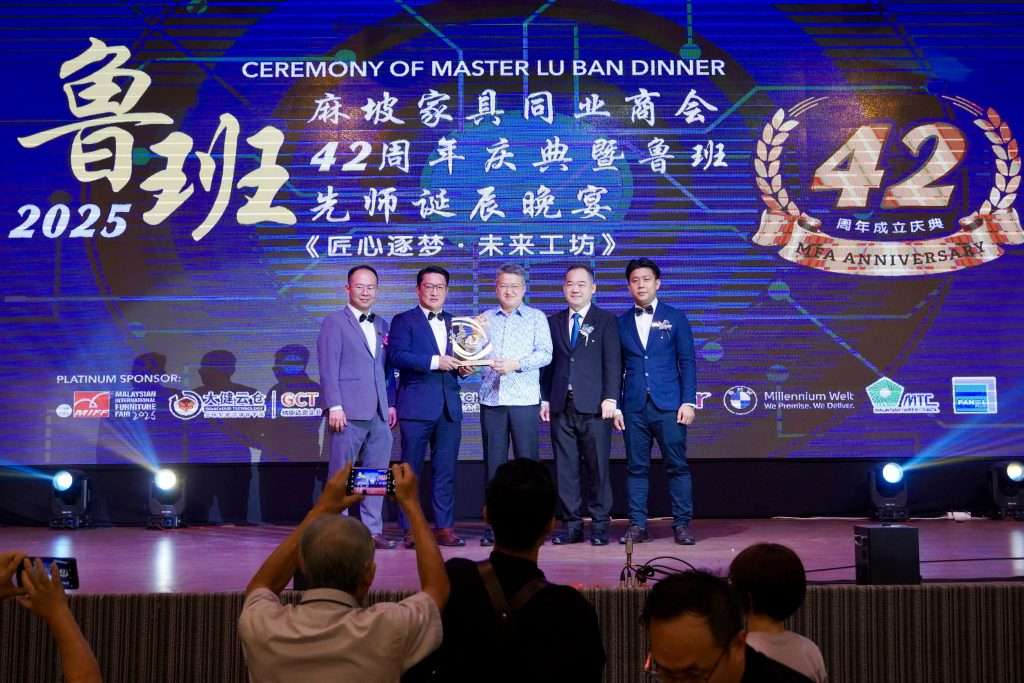
This is my speech delivered at the 42nd Anniversary Dinner of the Muar Furniture Association (MFA) held on 5 July 2025 at SKT Banquet Hall, Muar, Johor

