
The Social Exchange: Strengthening Malaysia’s Social Finance Ecosystem
The Social Exchange is a great initiative by the Securities Commission Malaysia (SC). It is not just an initiative, but a statement that we are not just thinking about the…


I would like to thank Organising Chairman Ng Jan Tzen and the team for making this happen. I would also like to thank the co-organisers FMM, JCI, MICCI, Pelita, as well as the venue provider University of Reading Malaysia, for doing this together.
And, of course, to all the exhibitors who believe in our vision, and all participants.
Why do we do this?
A society which has many happy workers earning decent pay with dignity at work and purpose in life is one that would see a virtuous cycle – a nation that all would want to belong.
Malaysia has been in a low wage, low cost, low skill cycle for too long. Graduate pay today is almost the same as 30 years ago, not to mention the pay for non-graduates. There are many who blame “competitiveness” or “productivity” of our youth as the cause of the problem. But that is not true.

Why are Malaysian wages so low?
It is because Malaysian wages are effectively set in Singapore and Bangladesh.
Let me explain. There are 1.1 million Malaysians working in Singapore, and there are easily more than 2 million Bangladeshis working in Malaysia.
I asked many of those who work in Singapore how much salary they are prepared to accept in order to come home to work in Johor, most said at least two thirds of Singapore pay.
With the Johor-Singapore Special Economic Zone, we have a unique opportunity to change.
Yet, many Malaysian employers only want to pay Bangladeshi workers-level wages for Malaysians, and yet expect them to work the same long hours as migrant workers. Such type of productivity is not what we want.
Productivity is not just how many hours a worker puts in. Productivity is about how much we invest in technology, how much we use automation, and now, how much we use artificial intelligence.
There’s of course a danger that AI will take away jobs. And, in my opinion, precisely because AI may take away jobs, we must now ensure that we create as many skilled jobs as possible for Malaysians.
To create more skilled jobs, we would need to reduce dependency on unskilled foreign labour as quickly as we could, and make available financial means to power technological upgrades.

What I just said has been identified by the Madani economy framework and the New Industrial Master Plan 2030. But we need to build societal consensus to do this together.
We need businesses to come together to start paying more to keep Malaysians working happily in Malaysia. We need businesses to invest in technology instead of keep on asking the government for more unskilled foreign workers.
Honestly, whoever comes to talk to me about wanting to hire more foreign workers, I would tell them I am against the idea. Instead, please come and talk to me about what the government can do to help you to transform in terms of technology, to open up new markets or to solve market access issues, and to ensure regulatory certainties to allow businesses to thrive.
Ultimately, I hope the government, the businesses, and everyone in the society put jobs at the centre of everything – a job-led growth industrialisation and model.

We need to create more decent jobs with decent pay for Malaysians. The task is more urgent now because the world has changed so much in 2025.
We are used to the export-led industrialisation model which presupposed suppression of wages in order to compete to export to the United States market at low price.
However, this model is ending in part because automation, AI and lights-off factories reduce reliance on cheap labour, making re-shoring to advanced countries a realistic possibility.
But more importantly, the United States clearly does not want to import so much as it prefers to re-shore as much as possible.
Therefore we need to create a market among our midst by paying Malaysians better, in the hope that they would consume, and thus creating a resilient domestic market to balance the global headwinds.

As a society, we need to ensure that the young would not feel alienated and vulnerable to the extent of causing job-related riots that we see in Indonesia and Nepal.
I hope the Good Jobs Career Fair will eventually inspire a Good Jobs Alliance among employers where they come together to create a trustworthy label as a group that offers decent jobs with decent pay for Malaysians, and for Malaysian consumers to recognise and choose to support these employers instead of those relying on foreign workers.
For instance, if a hotel hires 80% Malaysians and pay them a certain level of decent wages, say RM3,100, which is the living wage defined by GLCs, they can be considered a service provider with a “Good Jobs” label, and the consumers can choose to stay with them rather than those who do not. All GLCs and GLICs have committed to pay at least RM3,100 to their workers. It can serve as a benchmark.
Also, big retail chains are still paying just minimum wages and preferring to hire foreign workers. While the mom-and-pop shops need time to transition, there is no reason why big retail chains cannot pay better.

We can encourage Malaysians to consume at big retail chains or hotels that have a Good Jobs label and provide good jobs to Malaysians.
Through such consumer activism and employer consciousness, we help Malaysians get better pay and better jobs, which is a form of #kitajagakita, and to create a sense of real Malaysian solidarity.
Thank you for your support.
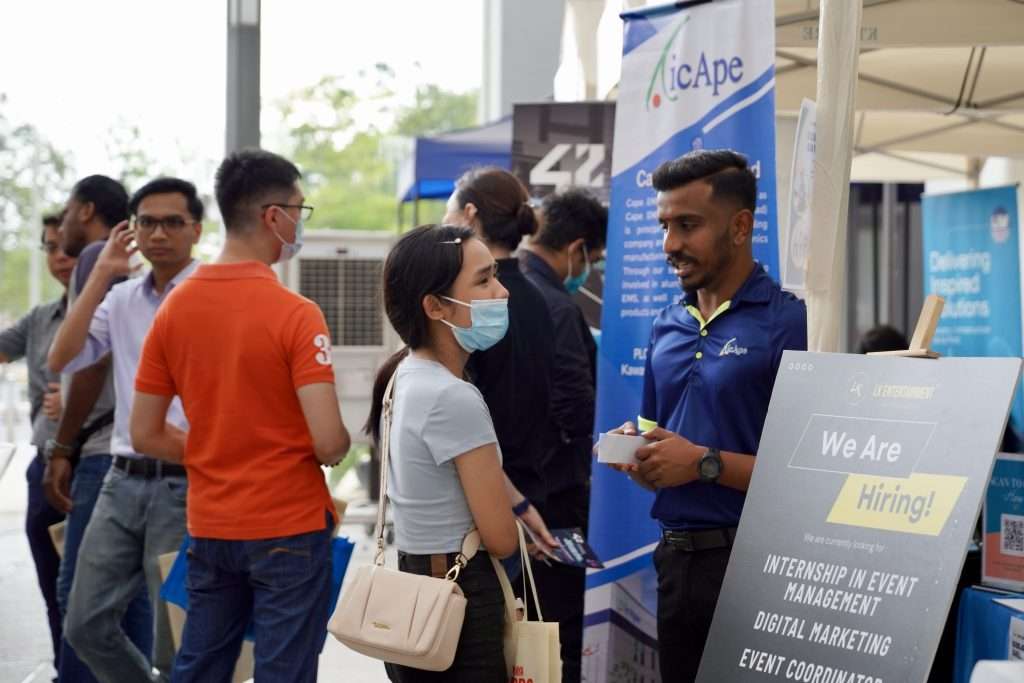
This is my speech delivered at the “Good Jobs” Career Fair held on Saturday, 20 September 2025 at University of Reading Malaysia, Iskandar Puteri.

