
The Social Exchange: Strengthening Malaysia’s Social Finance Ecosystem
The Social Exchange is a great initiative by the Securities Commission Malaysia (SC). It is not just an initiative, but a statement that we are not just thinking about the…

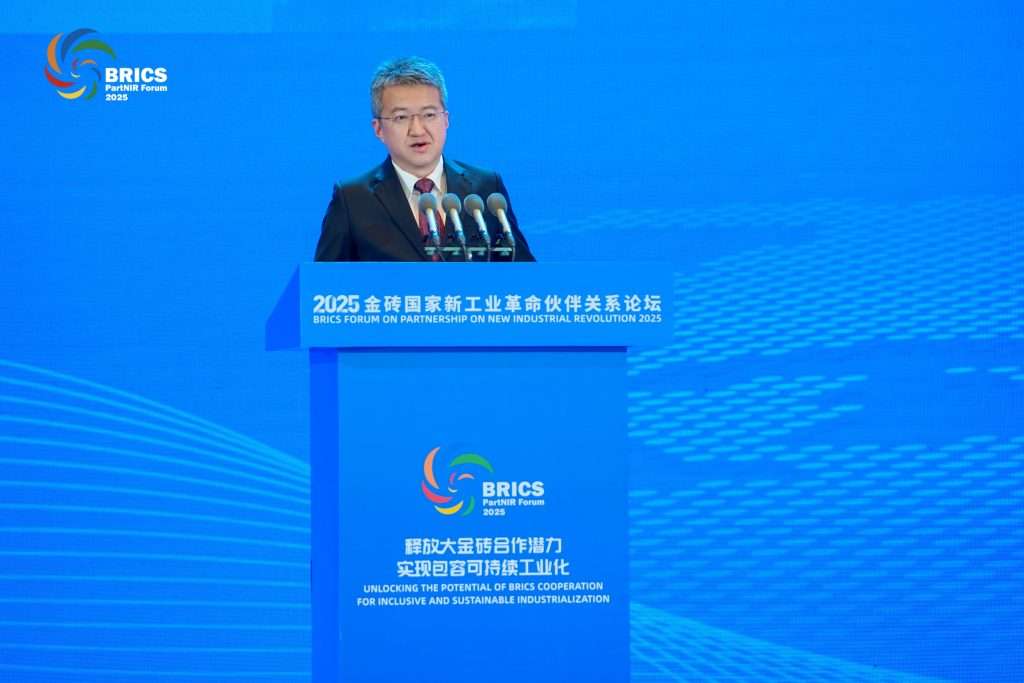
BRICS is currently the most important platform expressing the aspirations of the bottom billions of the world’s population in the Global South. BRICS is a shared commitment to resilience, sovereignty and mutual progress.
Following the end of the Second World War exactly 80 years ago, we saw the establishment of the United Nations and the shaping of a world order that continues to influence us until this day. Lest we forget when the United Nations was formed, there were actually very few independent nations. The world was then transiting from a largely imperial and colonial system to a community of sovereign nations.
The Bandung Conference in 1955 was the first major congregation of independent post-colonial nations. The giants of the developing countries, such as Sukarno of Indonesia, Zhou Enlai of China, Jawaharlal Nehru of India and Gamal Abdel Nasser of Egypt, came together to bring forth a message: that the bottom billions of the world’s population would like to close the development gap and have better lives, like those who lived in the advanced countries.
My country only gained independence in 1957, and in fact, on this day, 16 September, in 1963, formed the larger entity of Malaysia that includes Sabah and Sarawak. But the spirit of Bandung, the Non-Aligned Movement, and the Third World aspirations are at the very heart of Malaysia’s national sense of self.
Why is this relevant to today’s discussion? Because we must remind ourselves of our mission: that BRICS is the embodiment of the aspirations of the bottom billions of the world’s population seeking equitable development and the pursuit of decent lives for the many.
Over the past 80 years, while most of the world has seen an overall improvement of quality of lives, not many countries have managed to progress from the third world to become advanced economies with strong technological foundations.
China since 1978 and South Korea since a generation earlier are among the select few nations that saw the most dramatic rise in their economic, technology, industrial development and quality of life.
The Global South nations are now anxious. The challenges confronting BRICS and its partners are the following:
1. Can developing nations replicate the dramatic rise of China? What do we have to do together to make it happen? After rising to become a technology powerhouse, what can China do to help other Global South countries to do the same?
2. Can developing countries still rise when export-led industrialisation strategy is less feasible now with the advent of artificial intelligence, automation and lights-off factories, as well as the United States refusing to be the consumer of the last resort? We have to acknowledge that the rise of East Asian economies to a large extent were dependent on the outsourcing of manufacturing from the United States since the 1970s, and the United States serving as the consumer market of the first and last resort. The first Trump administration, the Biden administration and the second Trump administration have shown that there’s a bipartisan consensus in the United States to import less and to re-shore whenever possible. We will have to accept that the ever useful export-led industrialisation strategy will be less effective and have its importance further diminishing as time goes by.
3. Can developing countries still acquire and develop technologies with China having technological prowess, the economy of scale, and low price (in part due to involution or unhealthy price competition among China’s industries, a practice that the Chinese government is trying to reverse)? There is a concern among developing countries on whether they can still innovate technologies instead of just being users. Another related concern is the potential premature deindustrialisation in the developing world.
4. Can developing countries grow rich before they grow old as societies? Ageing societies, with the associated health challenges, are real and developing countries that currently still have demographic dividend will need to act fast to ensure that the general population is much richer before they get old, otherwise what would be at hand would be impoverished aged people in 20 years time.
5. Can we overcome the above challenges in the era of geopolitical rivalries and a permanent climate crisis, of which many developing countries are disproportionately adversely affected?
Thus, BRICS and its partners have to rally around this collective mission of creating technologies, jobs and wellbeing for the bottom billions of the world’s population, and have to do it fast.
Malaysia is the Association of Southeast Asian Nations’ (ASEAN) rotating Chair in 2025 and the theme for the year is “Inclusivity and Sustainability”, the twin objectives reflecting Prime Minister Datuk Seri Anwar Ibrahim’s idea of a “Madani” society, a progressive society of civilisational potential.
Malaysia’s New Industrial Masterplan (NIMP) 2030 sets out to achieve four concurrent missions, namely:
1. Increased complexities in our industry mix which translates into more value-adding and value extracting;
2. More technologies including digitalisation, automation, and artificial intelligence;
3. Towards Net Zero – to develop our economy while achieving climate goals;
4. Economic security for all – to spread the benefits of development to as many people as possible so as to ensure societal coherence and harmony, as well as genuine human development.
Malaysia hopes to move from the “Made in Malaysia” model which is essentially serving as contract manufacturers for multinationals, to the “Made by Malaysia” approach that would create Malaysian multinationals with technological innovation.
These missions and aspirations are not just for Malaysia. We believe all developing nations aspire to achieve the same. The ASEAN Community Vision 2045 espouses very similar ideas.
The world is entering a new phase of history. If we look back in 2045, we may conclude that 2025 is a pivotal year when the world changes course, as important as 2001 when September 11 happened, and the responses of United States that shaped the geopolitical landscape for 20 years, as well as the ascension of China into the World Trade Organisation which shaped global trade for two decades.
We are in such a moment of history that the Global South needs to create demand through jobs, create technologies, and maintain peace and wellbeing.
First, to create demand through jobs
The only way we could deal with the end of the United States as the consumer of the first and last resort is to create demand in the developing world. To create demand means we must ensure that our people have decent jobs with decent pay, and as many of them would emerge as middle class.
We should all take a leaf from the China experience. When China joined the WTO in 2001, there were only around 100 million Chinese who were considered middle class. Today, by any standard, 400-500 millions Chinese live middle class lives.
ASEAN currently has slightly less than 700 million population. If by 2045, a third to half of them become middle class, it is not just good for ASEAN, it is better for the world. ASEAN would not just be a production site but it will be a sizable consumer market for the world’s producers.
In this context and in the short term, we support President Xi Jinping’s effort to combat involution as price wars within China and the potential internationalisation of price wars may not help the development of China and the developing world.
In fact, this is probably the time to internationalise China’s “dual circulation” strategy – the balancing of the dependence on export with a much stronger domestic demand. To deal with the end of export-led industrialisation strategy, it is not only China that needs more domestic demand, ASEAN and other developing countries also need to work together to create domestic demand to sustain industrial capacity, technologies, and jobs.
Second, to create technologies
The world is often dominated by the priorities of the advanced economies. While there is too much attention being paid to the race to innovating the most advanced technologies, not much is being done for the programmatic proliferation of what I call “middle technologies” to the bottom billions of the world’s population.
We should create and proliferate middle techs that would vaccinate billions of poorer population against illness or to save them from dying from common illnesses; to build homes, roads and infrastructure efficiently and safely; to provide energy and clean water for those who have never had electricity and drinking water; and connect billions to the cyberspace. A good example was the “open source” Deepseek moment which we witnessed early this year. Techs do not necessarily need to be unaffordable. Making these middle techs common and affordable would do a great service to improve the quality of lives of the humankind.
Third, to maintain peace and wellbeing
Ultimately, our aspirations would come to nothing if the world could not maintain peace. Here, I would like to bring us back to the Bandung spirit of 1955: that much as the world was then just at the early days of the Cold War, the leaders of the developing nations pursued a non-aligned movement to stay above the fray from the threat of violence and wars, and to focus on the development of the wellbeing of the bottom billions of the world’s population in the Global South.
In the words of Zhou Enlai in Bandung 70 years ago: “What we Asian and African countries want is peace and independence. It is not our intention to make Asian and African countries antagonistic to countries in other regions. We want just as well the establishment of peaceful and co-operative relations with countries in other regions”.
In conclusion, the true potential of BRICS and its partners lie in our ability to create demand via jobs, to create technologies, and to maintain the peace and wellbeing in times of global strife.
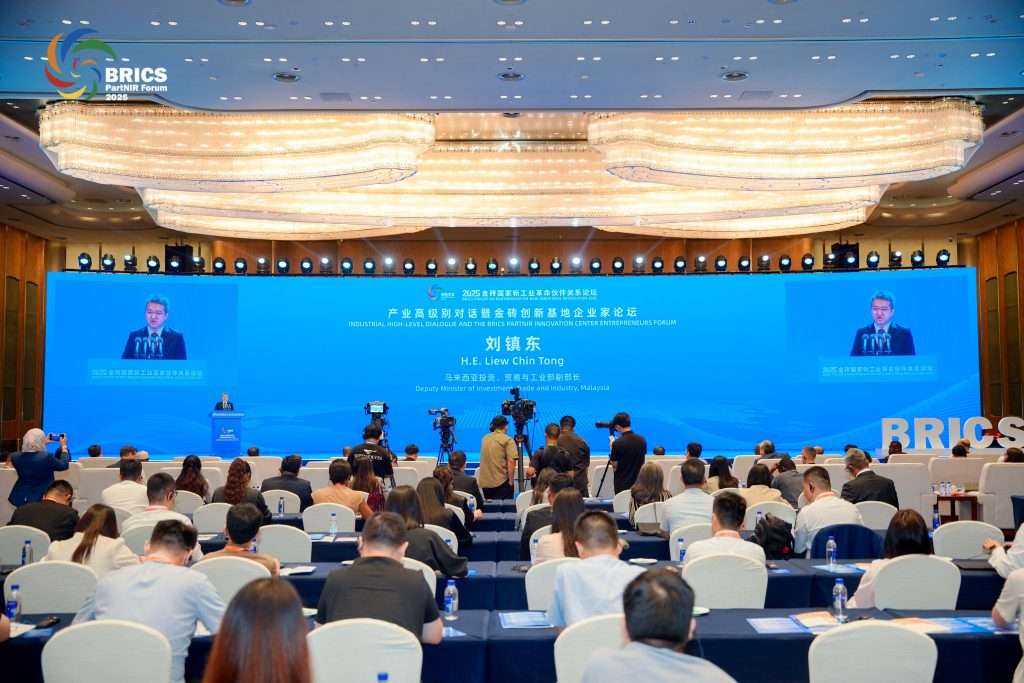
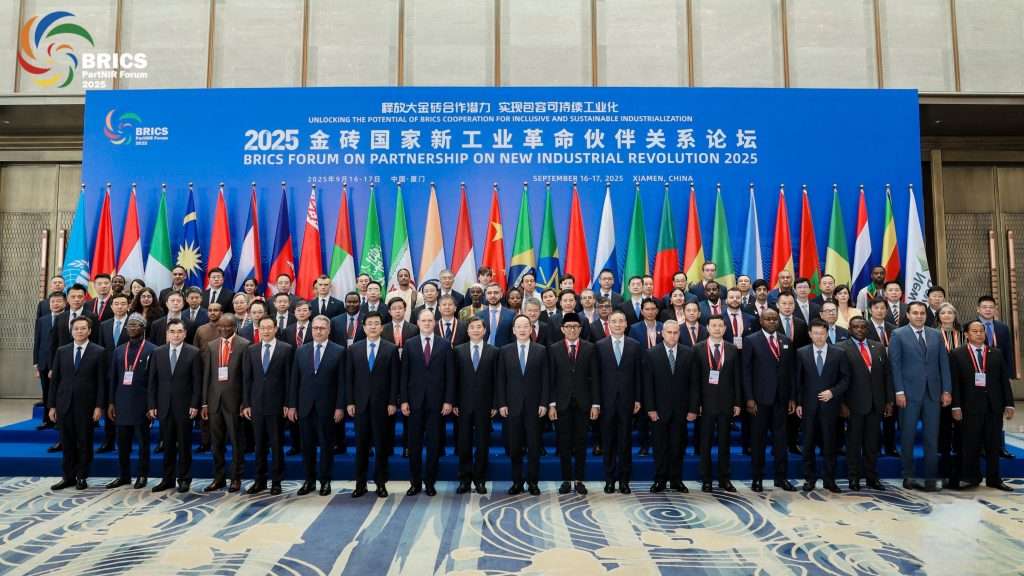
This is my speech delivered at the BRICS Forum on Partnership on New Industrial Revolution 2025 – Industrial High-Level Dialogue and the BRICS PartNIR Innovation Center Entrepreneurs Forum, jointly hosted by the Ministry of Industry and Information Technology of the People’s Republic of China, the People’s Government of the Fujian Province, the BRICS Partnership on New Industrial Revolution Innovation Center (BPIC), and the Xiamen Municipal People’s Government, on Tuesday, 16 September 2025, at the Xiamen International Conference and Exhibition Centre, Xiamen, China.

