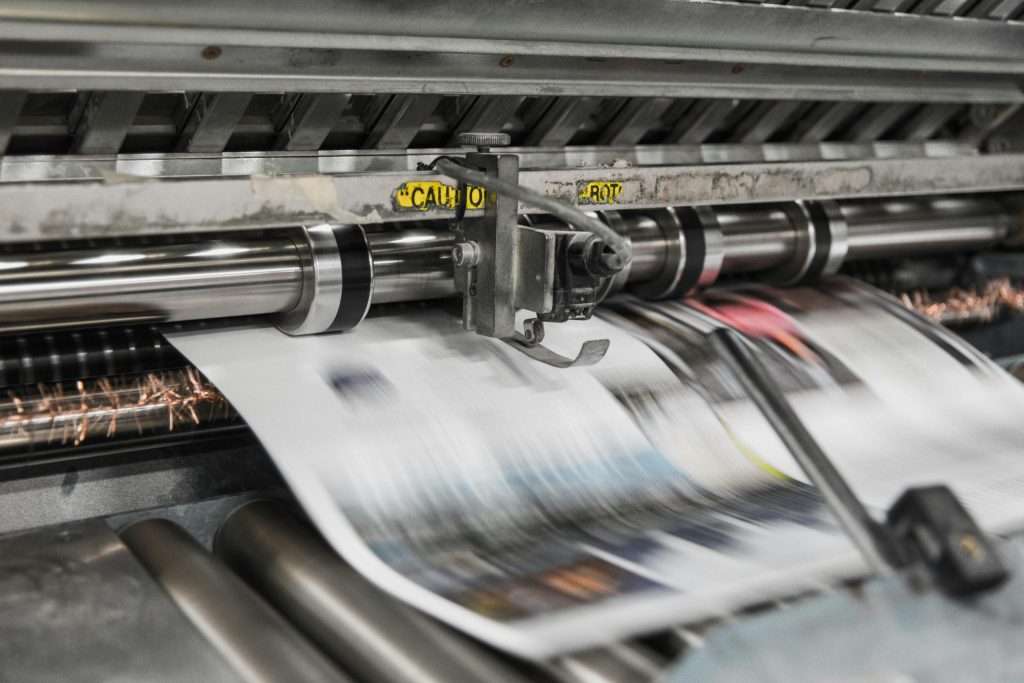
I come as a friend of the printing community, especially to Cheong Kok Wai of Vivar Print. He is the printer for my book Second Takeoff: Strategies for Malaysia’s Economic Resurgence. As I walked into the event, I saw Ms Lai Mei Ling of PNMB, whom I worked with when she was running Ultimate Print. I learnt from her the different print effects of simili 60g and 80g etc. She was very courageous to print the Rocket newspaper for me when the DAP was still a permanent opposition party.
My engagement with the printing community also included the Penang Monthly, a magazine which Datuk Dr. Ooi Kee Beng of Penang Institute and I launched in October 2009. Penang Monthly is still running uninterruptedly 15 years later.
I am intrigued by the theme of your event “print: re-imagined” and I understand that there’s this deep-seated anxiety among those in the printing community about digitalisation and the potential demise of the print industry altogether.
The theme reminds me of Benedict Anderson’s much-acclaimed book Imagined Communities: Reflections on the Origin and Spread of Nationalism (1983). Anderson was of the opinion that it was print-capitalism that created and fostered nationalisms. In Europe, before the widespread of nationalism, literacy was limited to a very small group of elite who could read and write Latin. When printing technology became simpler, cheaper and more widespread, novels and religious texts were written and printed in vernacular languages, which were previously spoken only. The printed texts in the respective vernacular languages outside Latin created conditions for literacy among ordinary people, eventually spreading the consciousness that is nationalism.
In other words, print-capitalism breeds and nurtures nationalism.
On this side of the world, it was Dr. Sun Yat-sen who promoted Chinese nationalism during the twilight of Imperial China by establishing newspapers such as Kwong Wah Yit Poh 光华日报 and “newspaper reading societies” (阅书报社) in Penang.
Today, even with widespread digitalisation, there are more and more very sizable bookstores opening in Kuala Lumpur, Penang, and Johor Bahru, among other places. Print will still thrive if more content is created, more magazines are published, and more books are written.
Malaysia is authentic and diverse. Kuala Lumpur and Malaysia are therefore uniquely positioned to be a great cultural hub for more interesting content to be created.
In the current multipolar world, Western conglomerates are not the only ones with capital. There are now many Arabs, Chinese and Indian leading businesses. Think about this: an Arab businessman would love to do business with his or her Chinese counterparts, but may not be comfortable to reside in China for three years. The same goes for a Chinese entrepreneur who may not be keen to live for an extended period of time in one of the Arab states. Malaysia is a Muslim-friendly country with a variety of halal food, which at the same time is also abundant with authentic and Malaysian-created Chinese and Indian cuisine, and many visitors will feel at home conversing and communicating with multilingual Malaysians.
Very few places around the world are as authentic yet as diverse like Malaysia. It is this cultural authenticity and diversity that I believe would fuel creativity, some of which would go into print form.
While the world enters a difficult and more volatile phase of history, it may just be Malaysia’s time to shine. I wish the printing community will find its role and be an integral part of Malaysia’s second takeoff.
This is my speech delivered at Selangor and FT Chinese Printing Presses Association 77th Anniversary on November 15, 2024.