
The Social Exchange: Strengthening Malaysia’s Social Finance Ecosystem
The Social Exchange is a great initiative by the Securities Commission Malaysia (SC). It is not just an initiative, but a statement that we are not just thinking about the…

Selamat sejahtera and Salam Malaysia MADANI,
Annyeonghaseyo and a very good morning.
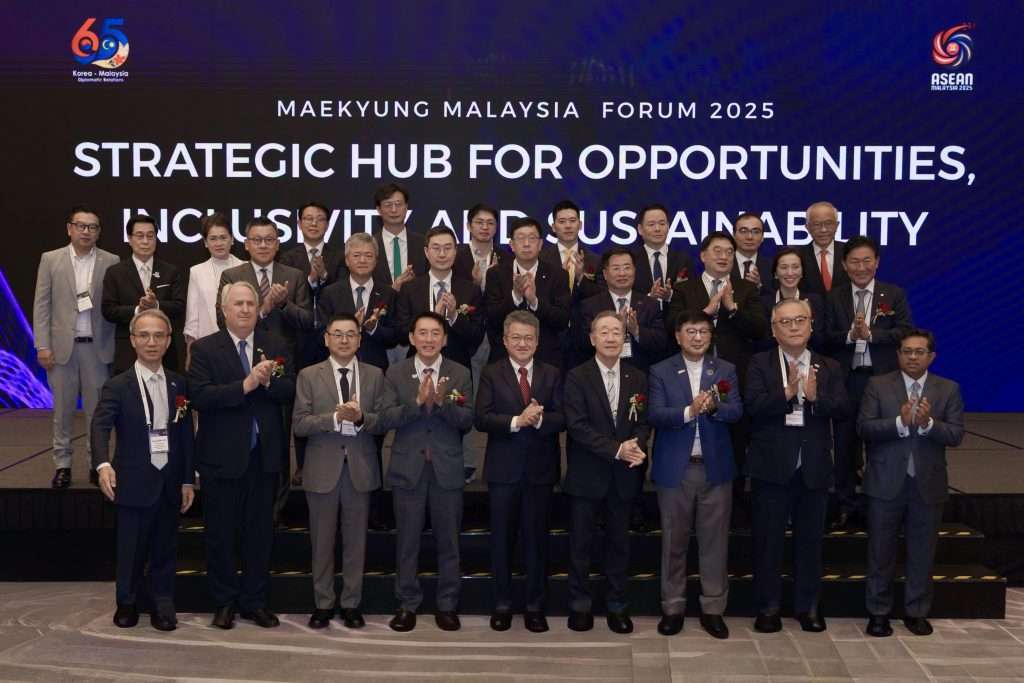
May I welcome you to Kuala Lumpur for the 33rd Maekyung Global Forum 2025, a truly significant gathering that brings together some of the sharpest minds and most influential leaders from both Malaysia and the Republic of Korea (Korea).
The Maekyung Global Forum was established by the Maeil Business Newspaper, and has become an eminent platform for dialogue and partnership across the dynamic Asia-Pacific region.
Malaysia is honoured that the Maekyung Forum has chosen to meet in Kuala Lumpur this year, gathering over 200 thought leaders from various fields participants.
Back in 2010, the Maekyung Forum held a special event here in Malaysia with the theme, “The next 50 years towards One Asia”, to celebrate Malaysia-Korea’s 50th anniversary. Fifteen years have passed since then, and it is a great privilege to have you return. I am confident that this year’s forum, themed “Strategic Hub for Opportunities – Inclusivity and Sustainability”, will serve as a meaningful platform to chart our next great leap forward together.
I first visited Korea in June 2006 and spent a month in Seoul and Jinju, GyeongsangNam-do. I was then studying a master’s degree at the Asia-Europe Institute of University of Malaya, and I went to Gyeongsang National University as an exchange student at the suggestion of my friend Dr. Hwang In-won.
I first met Dr. Hwang In-won in Kuala Lumpur in 1999 when he was a PhD student at the Australian National University, writing a thesis on Malaysian elite politics. He started it in 1992 and thought he would complete the thesis by 1998. However, in 1997, the Asian Financial Crisis happened, and a year later, the then Deputy Prime Minister Datuk Seri Anwar Ibrahim was sacked from UMNO and the government, and the politics in Malaysia changed altogether. Hwang had to rewrite some parts of his thesis which he eventually submitted in 2001. By then, I was already inspired by him to study at the ANU, and even rented a room from him.
There are three things that the rise of Korea inspired me: Korea became a democracy, a globally relevant culture power house, and most importantly, grew very rich, all within a generation’s time.
First, democracy
Through the stories Dr. Hwang and other Korean friends of the “386” generation shared with me, the Korean democracy experience is very relevant to Malaysia and to the rest of Asia.
Samuel Huntington called the dramatic democratisation of the Philippines in 1986, Korea and Taiwan in 1987, as examples of the Third Wave of democratisation.
The rest of Asia, including me, look to Korea as a role model. For instance, it was very inspiring for me to see Datuk Seri Anwar meeting President Kim Dae-Jung in 2006. Mind you, Anwar was just out of prison in 2004, and Malaysia was still a one-party state at that time.
It is not without challenges but as the failed December 2024 coup demonstrated to the world, the Korean democracy is not just a form but deeply ingrained in the minds of the ordinary people, and they would rise to occasion when democracy is under threat.
Second, a cultural powerhouse.
Perhaps Koreans themselves were surprised that their pop culture has such a huge global following, including in Malaysia. K-pop and K-drama are big in Malaysia, and many Malaysians enjoy visiting Korea!
We in Malaysia have a lot to learn from the creativity, and interestingly, the creative industry ecosystem that fuelled the global fascination with Korean culture.
Third, growing very rich in a generation
Malaysia and Korea were at a similar GDP per capita in 1960 but Korea grew rapidly to become a technology owner by the 1980s.
Here I am influenced by the views of Professor Ha-Joon Chang of University of London’s School of Oriental and African Studies, and Professor Keun Lee of Seoul National University.
Chang argued that Korea did not take the path counselled by the West to liberalise its economy but instead maintain a strong state involvement in shaping its industries, especially in fostering technology development.
The wealth of Korea did not come from real estate or any other speculative trades but from leading technology.
Keun Lee made the point that while Penang started the semiconductor industry around the same time as Korea, Malaysia still doesn’t have a mini-Samsung or own technologies because we failed to grow significant Malaysian technology champions.
The other point which I thought is interesting is Korea’s management of supply chain. Because Korea is technically still in a war-like situation, a former presidential advisor explained to me the extent to which Korea pays attention to the supply chain. Malaysia has to learn from Korea, and we should all learn from the experience during Covid to do more to ensure the resilience of the supply chain.
Of course, Korea is not without its fair share of problems such as ageing population, high inequality, and disenchantment among youth.
Some years later when we look back to 2025, historians would probably say this is a year when the world order shifted. A bit like 2001 when September 11 happened which more or less decided the security priorities of the United States for two decades, and when China joined the WTO, which set the scene for the global economy for 20 years until the Covid-19 pandemic.
We are now faced with a new global scenario, one that we have not experienced since the end of the Second World War. Many Asian nations grow rich by exporting to the United States, especially in the case of Korea, the dependence on the U.S. for market and for security shield is very significant.
How does Korea lead the region to imagine a world where we do not need to depend on the US market as much as we do now? We can’t just think about shifting to other markets alone as the industrial capacity of China, Japan, Korea and other Southeast Asian economies will try to do the same.
For example, the Trump tariffs on steel, imposed in March 2025 ahead of the reciprocal tariffs, have seen a surge of steel imports into Malaysia in recent months from China, Korea, Vietnam, and other countries. If the impact spreads to other industries, it will be a race to the bottom and a regional deflationary downward spiral if we are not careful in our thinking.
Asia needs a strong middle class to support and consume the industrial capacity that we collectively have, if we were to reduce our dependence on the US market. We will need to ensure that Korea, Japan, China, and ASEAN all have a robust middle class who could spend and have the disposable income to consume. Therefore, we need to make our citizens richer and economically more secure.
In this time of great transition, we look to Korea to play a more important international role.
In geopolitics, we look to Korea’s leadership in Asia with Japan, China, and ASEAN to maintain the peace in Asia.
In economics, Ha-Joon Chang’s book “Kicking Away the Ladder” posits that developed nations kicked away the ladder so that developing nations couldn’t follow their success. Developing countries in Southeast Asia want to be like Korea growing rich in a generation, and therefore we would like to see Korea in a more active position to help others to grow rich.
This year, Malaysia is the chair of ASEAN while Korea is the chair of APEC. We should do more to help ease Asia into the new phase of global history. And, to celebrate the 65th anniversary of Malaysia-Korea diplomatic relations.
I wish you well and have a good discussion.
This is my speech delivered at the 33rd Maekyung Global Forum held on Wednesday, 27 August 2025 at Grand Hyatt Kuala Lumpur.

